
Establishment and Registration
RIVACU LTD was registered on 31 March 1988 under the Co-operative Societies Act No. 14 of 1982 with Registration No. 5459. In 2023, the Union was also registered in the Co-operative Management System (MUVU) with Registration No. AFF-MNR-BBT-TC-2023-67.
Objectives of the Union
The main objective of RIVACU LTD is to collect, market, process, and sell agricultural produce in order to improve the economic welfare of its members through the development of crops such as maize, cotton, coffee, sunflower, legumes, and other suitable crops.
To achieve these objectives, the Union will:
-
1. Own large farms for mixed farming.
-

2. Promote modern agriculture using appropriate technologies and provide training.
-

3. Own agricultural tools and machinery.
-

4. Operate processing and value addition facilities.
-

5. Own transport and logistics equipment.
-

6. Ensure safety of assets through risk management and insurance.
-
7. Supply agricultural inputs and equipment.
-
8. Provide financial and administrative guidance to members.
-
9. Offer advisory services on development planning and budgeting.
-

10. Provide continuous education and training to members and leaders.
-

11. Undertake all lawful activities under Co-operative Societies Act No. 6 of 2013 and its 2025 amendments.
Area of Operation
The Union operates in Babati, Hanang, Mbulu (Manyara Region), and Ngorongoro and Karatu (Arusha Region). Headquarters are located in Babati Town, Ngarenaro area.
Membership
The members of the Union are affiliated primary Agricultural Marketing Co-operative Societies (AMCOS) located in the districts of Babati, Hanang, Mbulu, and Simanjiro in Manyara Region, as well as Ngorongoro and Karatu in Arusha Region.
Organizational Structure of RIVACU ltd
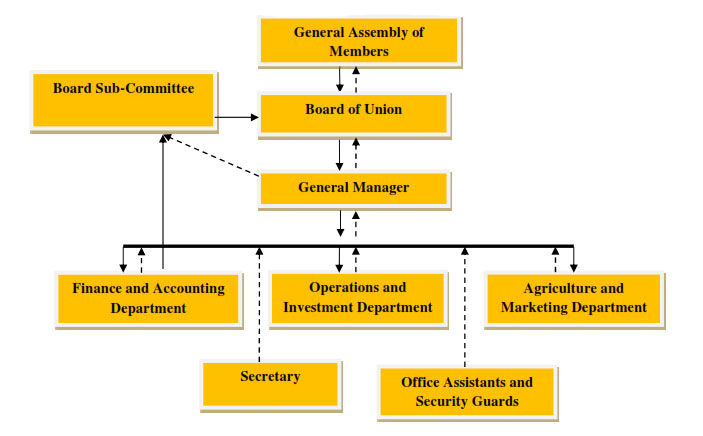
The supreme governing body of the Union, with final decision-making authority, is the General Assembly. All member societies are required to attend the General Assembly through their representatives, where all matters concerning the Union are discussed and voted upon. The day-to-day operations of the Union are managed by the Board of Directors, which is led by the Chairperson elected in accordance with the Union’s bylaws. The Manager of the union serves as the chief executive officer, responsible for overseeing the Union’s technical operations and supervising all staff under their authority.
VISION, MISSION AND philosophy
- Vision
- Mission
- Philosophy
To be a model co-operative union in Tanzania that strengthens primary co-operative societies in delivering quality economic and social services and alleviating poverty among their members.
To provide high-quality services in markets, agricultural inputs, representation, and education with professionalism and efficiency to primary co-operative societies, while promoting technology for national economic development.
RIVACU shall operate on the principles of integrity, goal orientation, and independence as required by co-operative principles. The Union will ensure that it delivers high-quality services to both the community and its members
core values of rivacu
i. To apply innovative approaches in meeting the needs of our customers/member societies in a timely manner.
ii. To promote mutual respect among customers/members and serve them with integrity and trust.
iii. To connect individuals, groups, and communities through innovation and collaboration with stakeholders.
iv. To deliver high-quality services that meet the needs of our customers and the wider community in order to improve their livelihoods.
v. To provide all our services with professionalism.
Sources of Funds
- Share capital as provided under Article 9 of the bylaws
- Affiliation fees from primary societies and annual member contributions as stipulated under Article 9
- Reserve funds and other funds established and approved by the Registrar as stated under Regulation 67 of the Co-operative Societies regulations
- Profits from the Union’s operations
- Loans from financial institutions and other sources as approved by the Registrar
- Commissions or levies on produce and other commercial charges arising from business conducted on behalf of members
- Grants, donations, subsidies, and other income
- Funds allocated as capital to members, as approved by the General Assembly and endorsed by the Registrar of Co-operative Societies
- Income from produce aggregation projects and sales through digital auction systems under the Warehouse Receipt System
